What does AI say about your business?
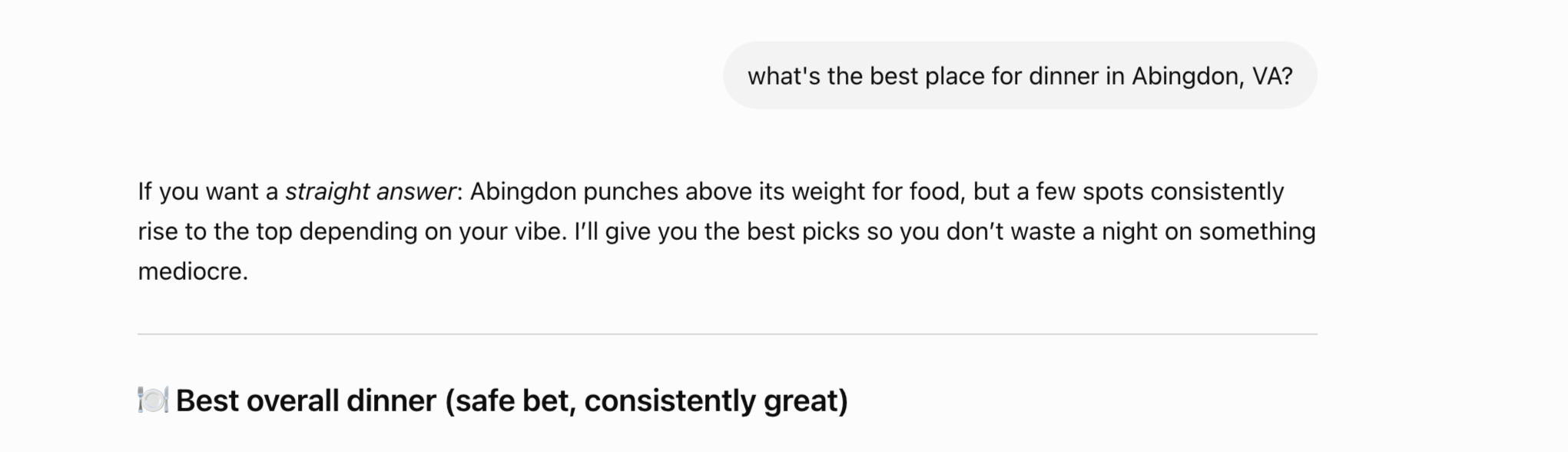
Picture someone three blocks from your front door. They pull out their phone, but they don't open Google and scroll. They open ChatGPT — or read the AI answer at the top of a Google search — and ask: "What's the best [your kind of business] near me?"
In a second or two, they get an answer. Not a page of links to wade through: a curated shortlist of the few places it recommends.
Here's the question worth sitting with: is that name yours?
For a lot of local businesses in Southwest Virginia and East Tennessee, the honest answer is "we have no idea" — and increasingly it's "no," or "the AI didn't mention anyone local at all."
What's actually changing in search?
For twenty years, getting found meant ranking in a list of blue links and letting people do the comparing. That's shifting. More and more, people ask a question and get a direct answer — from Google's AI summaries or assistants like ChatGPT, Claude, and Perplexity — without ever clicking through to a website. Here are some numbers:
Google's AI Overviews passed 2 billion users a month (Google, mid-2025), and 44% of U.S. adults now say they've used ChatGPT — up from 34% a year earlier (Pew Research Center, June 2026).
When an AI summary appears atop a results page, people click through to an actual website in only about 8% of searches — barely half the rate without one (Pew Research Center).
Gartner predicted in 2024 that search engine volume would drop 25% by 2026. That hasn't happened — Google still holds most of the market. But the shift it pointed at is real, and it's showing up in clicks rather than in searches.
In short: the search box that returns ten options is being replaced by an assistant that just hands over the answer. And the answer is short.
Why does this matter so much for a local business?
Because the AI doesn't show you everyone — it picks. Ask for "the best coffee shop in Abingdon" and it names the few businesses it has clear, consistent, trustworthy information on.
It's the same fight local businesses always had, in a new arena. Around here, great businesses rarely lose because they're worse than the chain down the road — they lose because the chain is easier to remember, and now easier for an AI to recommend. Being the name the AI gives is the new version of being top-of-mind.
The good news: almost no local business has done anything about this yet. When we check what AI says across Johnson City, Kingsport, Bristol, and Abingdon, the most common result is… nothing — a national chain, a competitor, or a shrug. That's open territory, and the first business in each category to become the trusted answer will be very hard to catch.
Five things to tell your team about AI search
If you want to bring your team up to speed without a 40-minute meeting, here are the talking points — short enough to repeat over coffee:
People are starting to ask, not search. They ask an assistant for a recommendation and get a handful of names back, not a page of links.
AI gives a short answer. Being one of those few names is the whole game now — there's no "page two" to be found on.
Right now, AI usually names no one local. For most categories in our region, that spot is wide open.
AI trusts businesses with clear, consistent, well-reviewed information. Messy or missing info means the AI can't confidently recommend you.
This is fixable, and early movers win. The businesses that sort this out first become the default answer — and stay there.
That's it. If your team understands those five things, you're already ahead of almost everyone in town.
What can you actually do about it?
You don't need to become an AI expert. You need to be the kind of business AI feels safe recommending. The fundamentals:
Make your information consistent everywhere. Same name, address, phone, and hours on your website, Google Business Profile, and every directory. Inconsistency makes AI hesitant.
Keep your Google Business Profile current and your reviews fresh. AI leans heavily on these — recent, real reviews are one of the strongest "this business is legit and loved" signals there is.
Answer the real questions your customers ask, in plain language, on your own site. The more genuinely helpful your content, the more likely AI is to pull from it.
Check where you stand. You can't fix what you can't see.
None of this is magic. It's steady, identifiable work that tends to show real movement in a couple of months.
So… what does AI say about your business?
Most local owners have never checked — and it's usually an eye-opening few minutes, sometimes encouraging, often a wake-up call.
Start with the Local Marketing Scorecard, free, 24 questions. Question 8 asks whether you know who AI names in your category. If you don’t, say so when you send us your score and we’ll run the check for you.
Because in a world where people ask instead of search, you want to be the answer. We help local businesses across Southwest Virginia and East Tennessee become exactly that.
Sources
All figures checked against primary sources on July 28, 2026.
Google, AI Overviews monthly users — 2 billion as of Q2 2025 earnings (July 2025).
Pew Research Center, Americans and AI 2026 (June 17, 2026). 44% of U.S. adults have used ChatGPT; 49% have used an AI chatbot.
Pew Research Center, Google users are less likely to click on links when an AI summary appears (July 22, 2025). 68,879 tracked searches; 8% click-through with an AI summary vs 15% without.
Gartner, Gartner Predicts Search Engine Volume Will Drop 25% by 2026 (February 19, 2024).